
Product Spotlights
NovaStar H-Series: video processing for multi-display systems and large LED canvases
Arrange multiple video sources across large LED walls and coordinated display layouts, with the processing, outputs, and operator controls selected for the complete system.
By XL AV ·
All Product Spotlights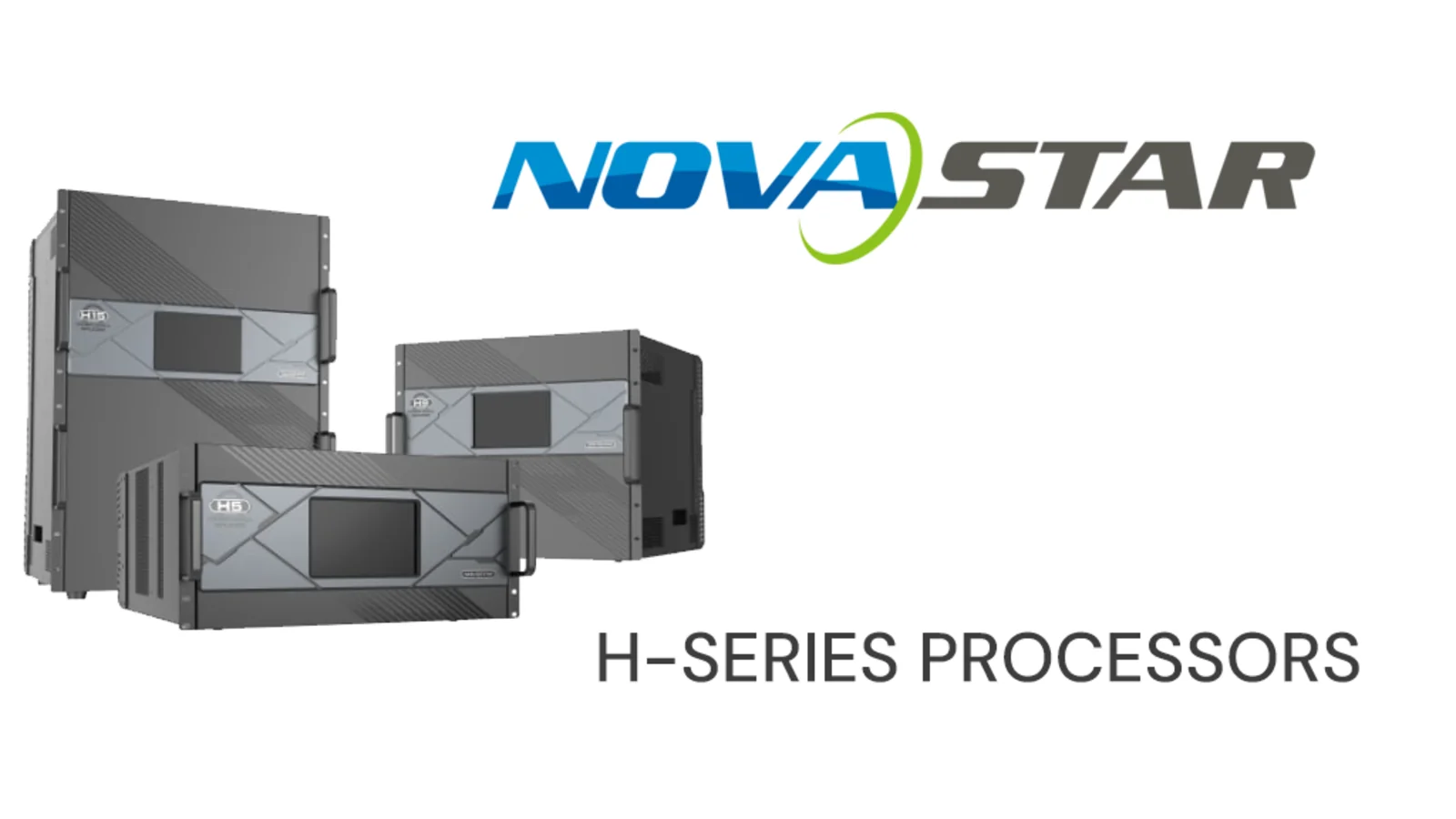
One system for sources, layouts, and display outputs
A control room may need operational dashboards beside camera feeds and a shared presentation. A large boardroom may need remote participants on one side of an LED wall and detailed documents on the other. A venue may have several display surfaces that need different content under coordinated control.
The NovaStar H-Series is a modular video-wall processing platform we can evaluate for these applications. With the appropriate cards, it combines video processing and LED sending in one chassis. Its role is to organize source images into the required display layouts and deliver those images through the selected outputs.
XL AV starts with what each screen needs to show, how many sources must be visible at once, and how operators will change the layout. Those requirements determine whether an H-Series configuration fits the project.
Reference: NovaStar H-Series overview
Map video onto a canvas
A canvas is the pixel-coordinate workspace used to arrange the displayed image. We define its dimensions, then position source windows within it. A window may occupy the entire image, share it with other sources, or present a cropped portion of a larger source.
Output mapping assigns portions of that layout to the actual display connections. A continuous LED wall needs its cabinet and receiver connections mapped correctly; a tiled LCD wall needs its panel arrangement considered. Physically separate displays can be configured as separate destinations with layouts appropriate to each audience.
For example, a hypothetical 7,680 × 2,160-pixel canvas contains about 16.6 million pixels. That calculation describes the image area, but the proposed processor still needs enough compatible outputs, appropriate width and height support, and processing capacity at the intended frame rate. XL AV checks the complete configuration.
This type of canvas mapping arranges video across display pixels. Projection onto curved or irregular architectural surfaces may also need geometric warping, edge blending, and specialized media-server functions. Those requirements are assessed separately.
Reference: NovaStar screen configuration guide
Build useful layouts with layers and presets
The H-Series supports layers, source cropping, backgrounds, on-screen text or graphics, and saved presets. These functions allow an operator to move between prepared layouts instead of rebuilding the screen during an event or meeting.
A boardroom might have a presentation layout, a hybrid-meeting layout, and a full-screen video layout. A control room might have an overview layout and a more detailed view for a specific operational task. We establish the required arrangements with the people who will use them.
Layer capacity depends on the chassis, output-card configuration, and the dimensions of the source windows. We count the sources that must appear simultaneously and validate the proposed layouts. The largest advertised layer number alone does not establish that every desired layout is supported.
Reference: NovaStar H-Series manual: layers, cropping, and presets
Coordinate several displays with different content
An H-Series design can support multiple screen destinations using the appropriate output configuration. That is useful when a main media wall, side displays, or an operator display must show different material while remaining part of a coordinated system.
We define each destination’s native resolution, purpose, and source requirements. A public-facing screen may need a clean presentation while an operator needs a monitoring view. We confirm which outputs can be independently assigned and how the proposed layouts share processing resources.
LED sending cards and conventional video-output cards serve different connections. The selected architecture may send directly to compatible LED receiving hardware or provide video to downstream equipment. XL AV verifies the display interfaces and receiver ecosystem rather than assuming one output method suits every screen.
Reference: NovaStar H-Series card options and specifications
Control rooms built around the operator’s work
A control-room wall can bring dashboards, live feeds, workstation outputs, and incident information into a shared view. Useful design begins with the decisions operators need to make and the information they need to see together.
XL AV plans text size, viewing distance, source availability, layout recall, and the steps for bringing important information forward. We also establish who can change layouts and which functions should be available through a room control interface.
Video-wall processing presents the sources. Functions such as camera recording, analytics, desktop access, and keyboard-and-mouse control require their own systems or integrations. We identify those requirements early so the complete control room supports the intended workflow.
Large fine-pitch LED walls need a matching signal path
A fine-pitch LED wall can present detailed material across a large surface. To retain that detail, the source resolution, capture interface, processing configuration, and display mapping need to work together. Enlarging a low-resolution source does not add detail to small text.
XL AV can pair an appropriate H-Series configuration with compatible LUXVISION LED display systems. For close-view corporate or control-room content, ECOLUX HD X is a family we can evaluate against the required size, pixel pitch, seating distance, and image detail.
We coordinate the LED receiving hardware, colour processing, refresh requirements, cabling, and output loading with the display design. High bit-depth or HDR operation is specified only where the selected sources, cards, firmware, receiving system, and display support the intended mode. Performance limits must be checked for that complete signal path.
Select the input and output cards for the sources
NovaStar lists H-Series input options covering connections such as HDMI, DisplayPort, SDI, HDBaseT, and network video, with separate cards for particular interfaces and formats. Output options include LED sending and conventional video connections. The chassis is populated to suit the application.
A camera feed, a graphics workstation, a conferencing system, and a network stream have different requirements. XL AV checks format, frame rate, colour requirements, source compatibility, content protection where applicable, and the number of simultaneous connections. Optional network-video formats require the relevant card and compatible infrastructure.
We confirm the exact part numbers and supported firmware during design. A capability appearing in the family catalogue should not be assumed to be present in every chassis or card combination.
Reference: NovaStar downloads: H-Series specifications and firmware
TAA configurations with Canadian-made LUXVISION displays
NovaStar offers TAA-compliant H-Series chassis manufactured in Cambodia. The input and output cards are manufactured in China. These chassis options allow us to include the H-Series in planning discussions for projects with TAA procurement requirements.
XL AV can combine an appropriate H-Series configuration with TAA-compliant LUXVISION LED displays manufactured in Canada. We select the display, processing chassis, and cards around the required canvas, source connections, and operating workflow.
For a TAA-related specification, we identify the exact chassis, installed cards, and display models and obtain the applicable manufacturer origin and compliance documentation for the proposed configuration.
H2, H5, H9, H15, and H20: choose capacity around the design
The H2 is the compact 2U option. We would evaluate it where the input count, output count, and processing requirements fit a smaller configuration.
The 5U H5 provides a larger modular platform for projects needing more input connections. The 9U H9 provides further expansion, with standard and Enhanced variants that have different output resources.
The 15U H15 addresses larger configurations, again with standard and Enhanced versions. The 20U H20 is the largest chassis in the published comparison and is an option for extensive source and output requirements.
We select between these models using a source schedule, output schedule, native pixel dimensions, simultaneous layouts, and any backup requirements. Chassis size, occupied slots, card availability, power, cooling, rack access, and planned expansion are all part of the decision. Published maximum pixel capacities vary with the output-card type and operating conditions.
Reference: NovaStar 2026 solutions brochure: H-Series selection guide
Presets, monitoring, and room controls
The H-Series provides browser-based operation, while supported control interfaces allow integration with a wider room-control system. XL AV can configure routine controls around the agreed workflow, such as recalling a presentation layout or selecting a source.
Input and output preview requires the appropriate preview hardware and configuration. We specify monitoring as a requirement where operators need to check a source or layout without relying only on the audience-facing screen.
We also plan network access, user permissions, configuration backups, documentation, and training. Administration tasks and routine operation can have different access requirements. Operators need a clear process for returning to a known layout after an unexpected source change.
Reference: NovaStar H-Series operation workshops
Plan backup around the required level of continuity
For a control room or other continuously used installation, we establish which failures the system needs to tolerate. NovaStar describes source, power, and device backup options within the H-Series family, but the available protection depends on the selected model and system design.
XL AV defines the backup source paths, power arrangement, spare equipment, and changeover procedure appropriate to the project. We test the agreed recovery behaviour during commissioning. Optional backup hardware must be included in the design; the family name alone does not provide a complete redundant system.
Processing supports the content and the room
The H-Series organizes incoming video. Playback computers, media servers, scoring systems, or other source equipment supply the content. An immersive or interactive project may also need synchronized playback, creative production, sensors, or specialized processing.
XL AV can help define the complete scope: display selection, source devices, processing cards, output mapping, cabling, controls, and audio integration. Bring your display dimensions, source list, example layouts, viewing distances, and operating requirements to a consultation. We will identify the configuration, compatibility checks, installation work, and training needed for your system.
Additional reference: Official NovaStar H-Series product information. Manufacturer information reviewed October 26, 2026. Exact chassis, card revisions, firmware, loading limits, and availability are confirmed during project design.